


How to Fix Chronic Desk Neck Pain: A Practical Guide
Table of Contents
Why Desk Work Causes Chronic Neck Pain
Ergonomic Workstation Setup: Getting the Measurements Right
Monitor Height, Distance and Chair Position
Laptop vs Desktop: Why It Matters for Your Neck
Exercises for Desk Neck Pain You Can Do at Your Desk
Tier 1: Activation (weeks 1-2)
Tier 2: Endurance and range (weeks 3-6)
Tier 3: Load and capacity (week 6 onward)
How to tell it is working
Remedial Massage for Neck Tension: What to Expect
Does Remedial Massage Help Back Pain Too?
Daily Habits and Movement Breaks That Prevent Stiffness
The movement-break rule
Equipment on any budget
The stress-pain cycle
A realistic recovery timeline
When to Seek Professional Help for Persistent Neck Pain
Frequently Asked Questions
Last Updated: October 2, 2026
Why Desk Work Causes Chronic Neck Pain
Desk neck pain is the stiffness, ache or burning feeling that builds in the neck and shoulders after long hours at a screen. It happens because the head drifts forward, the deep neck muscles tire, and the joints of the cervical spine sit in one position for too long. (Source: ergonomic principles for computer workstations)
At Fix My Muscles, we treat this pattern most days of the week. The neck rarely fails on its own. It fails because the desk, the chair and the daily routine all push the head forward, hour after hour.
Three things drive most cases:
Sustained posture. Holding any position for hours loads the same tissue.
Weak deep neck flexors. These small muscles give up first, so the upper traps take over.
No movement breaks. Tissue needs load changes to stay healthy.
Ergonomic Workstation Setup: Getting the Measurements Right
An ergonomic assessment comes down to a few numbers. Get the monitor height, screen distance and chair position right, and the neck stops doing unpaid overtime.
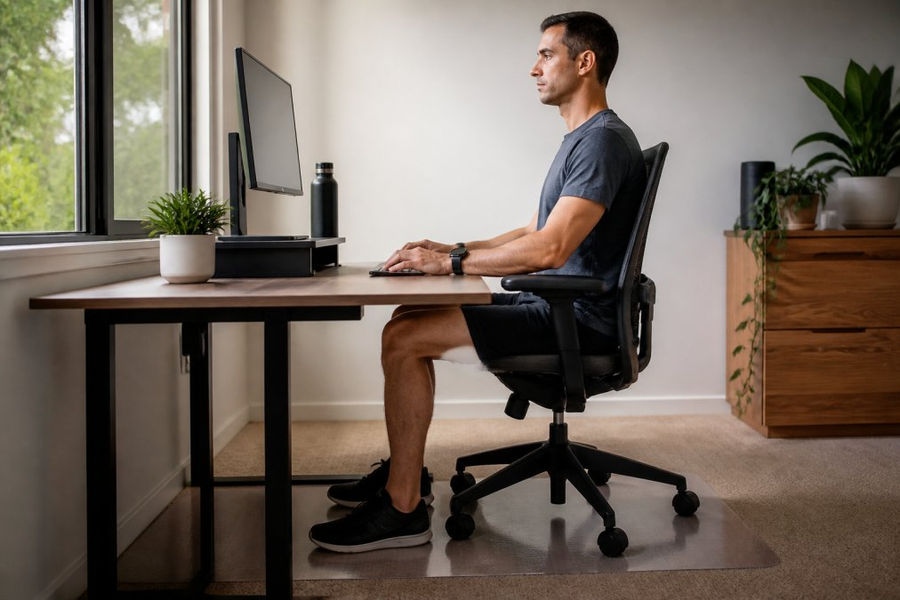
Monitor Height, Distance and Chair Position
Set the top third of the screen at eye level so the gaze drops slightly. Sit about an arm's length from the monitor, roughly 50 to 70 centimetres. Set the chair so elbows rest near 90 degrees and feet sit flat.
Laptop vs Desktop: Why It Matters for Your Neck
A laptop forces a choice: neck down or arms up. Neither is good. Use a riser or stand so the screen reaches eye level, then add a separate keyboard and mouse.
Exercises for Desk Neck Pain You Can Do at Your Desk
Exercises for desk neck pain work best in short, frequent bursts. Two minutes every hour beats twenty minutes once a week. The reason is mechanical: the deep neck flexors and lower trapezius are endurance muscles. They respond to low load applied often, not to one heroic session.
Tier 1: Activation (weeks 1-2)
Chin tucks. Sit tall, draw the chin straight back, not down, until you feel a gentle stretch at the base of the skull. Hold five seconds, ten reps, three times daily. A common mistake is jutting the chin down instead of gliding it back; do it in front of a mirror for the first few days.
Shoulder blade squeezes. Pull the blades together and slightly down, hold five seconds, ten reps. Keep the shoulders away from the ears.
Neck rotations. Turn slowly left and right, five each side, stopping before any pinch or sharp pain.
Tier 2: Endurance and range (weeks 3-6)
Chin tucks against light resistance. Place two fingers on the chin and press gently as you tuck. Hold ten seconds, eight reps.
Wall angels. Stand with the back of the head, upper back and pelvis against a wall. Slide the arms up and down while keeping contact. Ten slow reps.
Upper trap stretch. Tilt the ear to the shoulder, hold twenty seconds per side, two rounds. Keep the opposite shoulder relaxed rather than pushing it down hard.
Tier 3: Load and capacity (week 6 onward)
Prone Y-T raises. Lie face down and lift the arms into a Y, then a T, squeezing the mid-back. Ten reps of each.
Band pull-aparts. Hold a light resistance band at chest height and pull it apart, squeezing the blades. Fifteen reps.
Deep neck flexor holds. Lie on your back and perform a chin tuck, then lift the head just off the floor for ten seconds. Six reps.
How to tell it is working
A useful rule of thumb: symptoms should ease during the session and stay no worse the following morning. If pain climbs steadily over three sessions, drop back a tier. If a movement causes tingling, numbness or pain shooting into the arm, stop and get it assessed rather than pushing through.
Pro Tip Set a recurring timer rather than relying on memory. Most people intend to exercise hourly and manage two or three rounds a day at best.
Remedial Massage for Neck Tension: What to Expect
Remedial massage for neck tension targets the muscles and connective tissue that have tightened over months of desk work. It is a treatment, not a relaxation session.
Does Remedial Massage Help Back Pain Too?
Does remedial massage help back pain? Yes, for many people with muscular back pain. The same drivers behind desk neck pain, long sitting, weak support muscles and trigger points, also load the lumbar spine.
Daily Habits and Movement Breaks That Prevent Stiffness
Preventative care beats reaction. Small habits, repeated daily, keep the neck and shoulders from seizing up. But habits only stick when they are specific, cheap and tied to something you already do.
The movement-break rule
Stand and move every 30 to 45 minutes. Set a timer rather than relying on memory, and anchor the break to an existing trigger, the end of a meeting, a phone call, or a page of work. Swap one coffee break for a short walk. Adjust your screen before you start work, not after the ache begins.
Habit | How Often | Why It Helps |
Movement break | Every 30-45 min | Reloads tired tissue |
Chin tucks | 10 reps, 3x daily | Wakes up deep neck muscles |
Screen height check | Start of each day | Stops forward head drift |
Walk break | 1-2 per day | Eases the whole spine |
Equipment on any budget
You do not need a new chair to make a difference. Work through these tiers in order, because the cheapest fixes often deliver the biggest change.
No-cost fixes. Raise the laptop on a stack of books or a box, then use a separate keyboard and mouse. Sit on a folded towel if the chair is too low. Move the monitor directly in front of you rather than off to one side.
Low-cost additions. A laptop stand, an external keyboard and mouse, and a footrest cover most home setups. A rolled towel behind the lower back adds lumbar support.
Worth investing in. An adjustable chair and a monitor arm let you fine-tune height and distance as your posture improves.
The stress-pain cycle
Chronic neck pain is not only mechanical. Pain that lingers for months changes how the nervous system interprets signals, and stress, poor sleep and low mood can turn the volume up. That is not "in your head", it is a well-recognised part of persistent pain.
Practical steps that help:
Keep a simple two-line daily note of pain level and stress level. Patterns usually appear within a fortnight.
Protect sleep. Most adults need seven to nine hours, and poor sleep lowers pain tolerance.
Use slow breathing for two minutes during a flare rather than tensing against the pain.
Stay gently active. Complete rest tends to make persistent neck pain worse, not better.
A realistic recovery timeline
Weeks 1-2. Awareness and setup. Symptoms may fluctuate while you adjust.
Weeks 3-6. Early change. Movement breaks and tier-one exercises start to feel easier, and end-of-day ache often reduces.
Weeks 6-12. Consolidation. Strength and endurance build, and flare-ups become shorter and less frequent.
Beyond 12 weeks. Maintenance. The habits become automatic, and hands-on treatment is used to address specific restrictions rather than as a weekly crutch.
Key Takeaway Setup, movement and load progression do most of the work. Hands-on treatment helps when tissue has become restricted or when progress has stalled.
Ergonomic setup guidance for screen-based work Understanding persistent pain and the nervous system
When to Seek Professional Help for Persistent Neck Pain
See a qualified practitioner if pain lasts more than a few weeks, keeps waking you at night, or comes with numbness, tingling or weakness in the arm. Those signs need proper assessment.
Frequently Asked Questions
What are the common causes of a stiff neck from desk work?
Desk work forces the neck into a forward position for hours at a time. When your monitor sits too low or too far away, your head drifts forward and the muscles at the back of your neck work constantly to hold it up. Over months, this leads to muscle tension, trigger points and joint stiffness. Poor chair height, a lack of lumbar support and skipping movement breaks all add to the load. The result is the familiar ache and restricted turning that builds through the working week.
Can remedial massage help with chronic neck stiffness?
Remedial massage targets the muscles, fascia and trigger points that keep your neck stiff. A therapist assesses how you move, then works through the tight bands of tissue in your neck, shoulders and upper back. Techniques such as myofascial cupping and dry needling may be used alongside hands-on release. Many people notice improved range of motion and less tension after treatment. It works best combined with ergonomic changes and the exercises for desk neck pain covered in this guide.
How long does it take to fix chronic desk neck pain?
Timelines vary with how long you have had the problem and how consistently you address it. Someone with a few weeks of stiffness may feel noticeably better within two to four weeks of combined treatment, ergonomic changes and daily exercises. Chronic pain present for months or years usually needs a longer plan, often eight to twelve weeks, with regular check-ins. Your therapist can map out a realistic timeline after assessing your neck, posture and working setup.
Does remedial massage help back pain as well as neck pain?
Yes, and the two often go together. The same forward-head posture that strains your neck also loads your thoracic spine and lower back, especially during long sitting sessions. Remedial massage for back pain focuses on the muscles running along the spine, the hips and the shoulders. Releasing those areas takes pressure off the neck and helps you sit taller. If your back pain is persistent or comes with numbness or weakness, see a qualified health professional for assessment first.
Chronic desk neck pain rarely resolves by ignoring it, and it rarely resolves with one stretch you do once. It needs a better setup, a routine you repeat, and hands-on treatment when the tissue has already tightened. Fix My Muscles treats neck, shoulder and back pain with remedial massage, dry needling, myofascial cupping and the MARS approach, backed by HICAPS and private health fund rebates. Book now and start moving without the ache.
Book a Treatment


Comments