


7 Hands-On Treatment Options for Restricted Mobility
Last Updated: November 17, 2026
Quick Summary
Hands-on treatment for restricted mobility is an assessment-led approach where a practitioner uses joint mobilisation and soft-tissue techniques to improve how a joint moves and how surrounding muscles support it. Treatment is matched to the cause of the restriction, whether joint stiffness, soft-tissue tightness, injury guarding or motor control, and is combined with exercises you do between sessions.
A clinical mobility assessment includes history, whole-body observation, tissue isolation and a trial technique with immediate re-test.
Joint mobilisation uses slow, controlled oscillation or sustained pressure; soft-tissue work targets muscle, fascia and connective tissue.
The MARS approach combines Mobility, Activation, Release and Stretch, with the balance set by your assessment.
Mobility exercises work best short and frequent: three to five minutes, several times a day, five to ten slow repetitions.
Seek medical assessment first for night pain that wakes you, fever, numbness or weakness, or loss of bladder or bowel control.
Stiff and not sure where to start?
Hands-on assessment and treatment for restricted mobility, built around your movement goals.
Table of Contents
What Hands-On Treatment for Restricted Mobility Actually Involves
Hands-on treatment for restricted mobility is a structured, assessment-led approach where a practitioner uses manual techniques on joints and soft tissue to improve how a joint moves and how the surrounding muscles support it. Treating restricted mobility as a movement problem, rather than just a tight spot to press on, is an important distinction. (Source: Australian Institute of Health and Welfare report on musculoskeletal conditions)
Most people arrive at our clinic after weeks of stretching a muscle that was never the real culprit. A common mistake is assuming stiffness equals tightness, then stretching harder.
Below, we'll show you exactly what a proper hands-on assessment looks like, the techniques involved, and how to keep progress going between sessions. The Australian Institute of Health and Welfare report on musculoskeletal conditions shows these complaints are among the most common reasons people seek care.
What to Expect During a Clinical Mobility Assessment
A clinical mobility assessment is a physical examination of how you move, where movement stops, and what tissue is limiting it. It takes place before any treatment begins, and it drives every decision that follows.

Step 1: History and the Movement You Want Back
We start with a focused history: what movement is restricted, when it started, what makes it better or worse, and what you have already tried. The most useful question is functional rather than clinical, what specific task do you want to be able to do again?
Some presentations need medical assessment before any hands-on work, so red flags are considered at this stage (covered in the safety section below).
Step 2: Observing Whole-Body Movement
We watch you move before we press on anything. Expect to be asked to reach overhead, rotate, bend, squat and walk while the practitioner observes where motion deviates. We are looking for asymmetries, compensatory patterns and the point in the range where movement changes quality, not just where it hurts.
Step 3: Isolating the Limiting Tissue
From there, specific tests isolate joint range of motion, muscle strength and joint stiffness. Comparing sides tells us a lot. The key question we are answering is simple: is the limit coming from the joint, the soft tissue, or the way you are controlling the movement? Each answer leads to a different treatment plan.
Joint restriction: the joint feels blocked or hard at end range, with a clear capsular pattern
Soft-tissue restriction: range improves temporarily when the tissue is engaged, and the end feel is springy rather than hard
Motor control restriction: the joint has range but you cannot access it under load or without compensation
Step 4: Re-Testing After a Trial Technique
A useful assessment includes a brief trial of treatment and an immediate re-test. If we mobilise a joint or release a trigger point and the movement measurably changes, that confirms the direction. If nothing changes, we reassess rather than repeating the same technique harder. This trial-and-retest loop is what separates an assessment-led approach from a fixed routine.
Building an Individualised Treatment Plan
An individualised treatment plan sets out what we are treating, in what order, and what progress should look like. It combines hands-on work with movement tasks you do yourself. What most guides miss is that the plan should change as you improve, not stay fixed for six weeks.
If you want to understand what our hands-on work involves in more detail, you can read about our remedial massage for chronic pain and injury management.
Manual Therapy for Mobility: Joint Mobilisation and Soft-Tissue Work
Manual therapy for mobility covers two broad families of technique: joint mobilisation and soft-tissue work. Joint mobilisation uses controlled, graded movements applied to a joint to restore its glide and reduce stiffness. Soft-tissue techniques work on muscle, fascia and connective tissue to reduce muscle tension and restore length.
Neither technique works in isolation. Keeping the surrounding muscles engaged as the joint moves helps prevent stiffness from returning, which is why exercises for chronic shoulder stiffness should work alongside hands-on treatment.
Joint mobilisation: slow, controlled oscillation or sustained pressure into a joint to improve joint movement
Joint manipulation: a single, quick movement, used selectively and only where appropriate
Soft-tissue work: targeted pressure, friction and stretching of muscle and fascia
Dry needling: fine needles into trigger points to reduce muscle tightness
How Treatment Differs by Cause of Restriction
Restricted mobility is not one problem, and the technique mix should change with the cause. A common pattern is:
Joint stiffness (for example, after immobilisation or in osteoarthritis): graded joint mobilisation is the priority, with soft-tissue work to address the guarding that builds around a stiff joint
Soft-tissue tightness (for example, after repeated loading or poor recovery): release and stretch work lead, with mobility drills to maintain the range gained
Injury-related restriction (for example, post-sprain guarding): protection and progressive loading matter more than aggressive stretching, and treatment is paced to tissue healing
Chronic conditions and disability: the goal shifts to function and participation, with pacing and adaptation rather than pushing through pain
Motor control restriction: activation work is the priority, because the joint has range but you cannot access it under load
What the Evidence Actually Supports
The Cochrane review library on manual therapy evidence is a useful starting point if you want to read the research on what these techniques can and can't achieve.
Watch out: treating every restriction with the same technique because it worked for someone else is the most common way progress stalls.
Here is how the main hands-on techniques differ in what they do.
Technique | What it involves |
Joint mobilisation | Slow, controlled oscillation or sustained pressure into a joint |
Joint manipulation | A single, quick movement, used selectively and only where appropriate |
Soft-tissue work | Targeted pressure, friction and stretching of muscle and fascia |
Dry needling | Fine needles into trigger points to reduce muscle tightness |
Myofascial cupping | Suction-based work to lift and slide the tissue layers |
Remedial Massage for Stiffness and Muscle Tension
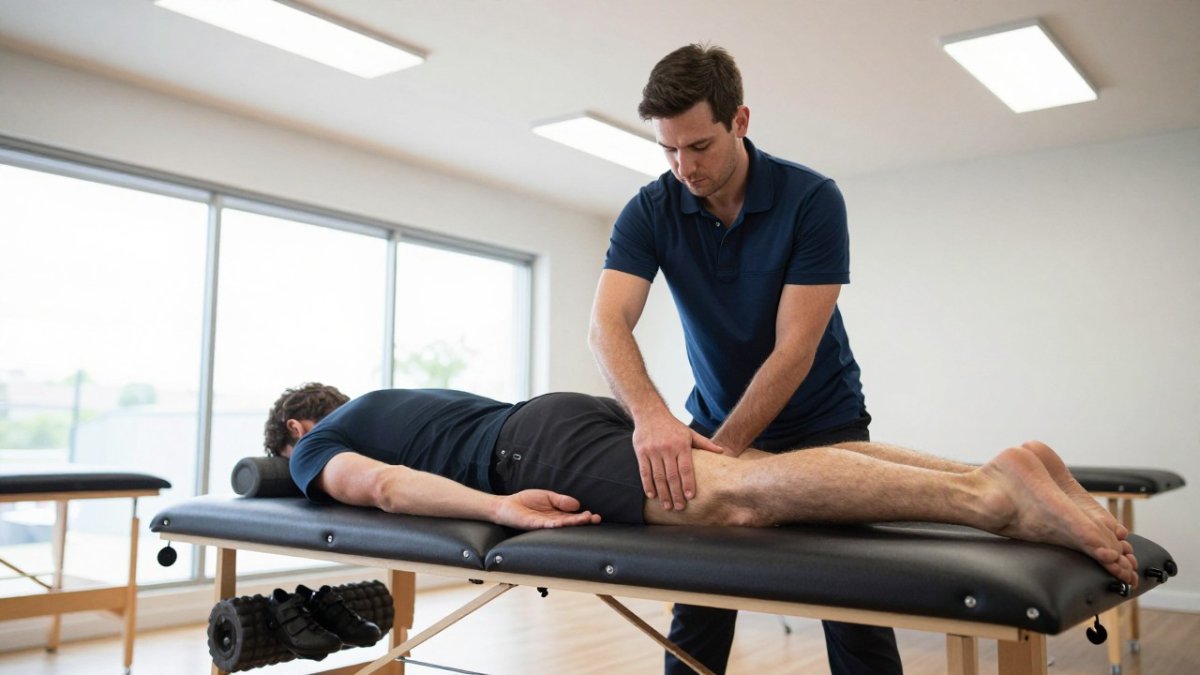
Remedial massage for stiffness targets the muscular side of a movement problem. It's a treatment-oriented form of massage, not relaxation massage, and the pressure, direction and depth are chosen to change tissue behaviour rather than simply to feel good.
Where does it fit? When muscle tension is guarding a joint and limiting movement, reducing that tension creates room for the joint work to hold.
A common mistake is chasing the sorest point session after session. The sorest point is often a symptom, not the cause.
The MARS Approach: Mobility, Activation, Release and Stretch
The MARS approach is a structured treatment philosophy built around four components: Mobility, Activation, Release and Stretch. Each component addresses a different part of the movement problem, and the balance between them is set by your assessment, not by a fixed protocol.
Mobility: restore joint movement and range of motion through mobilisation and controlled movement
Activation: wake up muscles that aren't contributing, so the new range is usable under load
Release: reduce muscle tension and trigger points through soft-tissue work, cupping or dry needling
Stretch: lengthen tissue and consolidate range using manual stretch therapy
The stretch component is where many people stall on their own. Our manual stretch therapy is delivered hands-on, which lets us take a joint through range safely while the surrounding tissue is being released.
Mobility Exercises for Stiff Joints to Do Between Sessions
Mobility exercises for stiff joints work best when they're short, frequent and specific to your restriction. Three to five minutes, several times a day, beats one long session on the weekend.
Here's a simple principle set we give most clients:
Move the restricted joint through its available range slowly, five to ten repetitions
Hold at the end of range for a few seconds without forcing it
Follow with an activation drill for the muscle that should be doing the work
Avoid aggressive stretching into pain, which often increases protective tension
Re-test the movement afterwards and note whether it changed
Movement quality matters more than repetition count. If the movement gets sloppy, stop and reset.
Watch out: pushing hard into a stiff joint to "break through" the restriction can irritate the tissue and set your progress back.
Safety, Limits and When to Seek Medical Assessment
Hands-on treatment is generally well tolerated, but it isn't appropriate for every presentation, and a suitable professional should be consulted when a presentation doesn't fit a musculoskeletal pattern.
Seek medical assessment first if you have unexplained weight loss, night pain that wakes you, fever, numbness or weakness in a limb, loss of bladder or bowel control, or pain following significant trauma.
Hands-on treatment is not a means of diagnosing or curing medical conditions. The healthdirect symptom checker and guidance is a practical resource for deciding whether to see a doctor.
Tracking Progress and Booking Your First Assessment
Progress tracking turns treatment from guesswork into something measurable.
If you're wondering how many sessions this typically takes, our guide on how many massage sessions for results sets out what realistic progress looks like over time. When you're ready to start, you can book online for a first mobility assessment, and you can review plans and pricing before you come in.
Restricted mobility rarely resolves by waiting, and it rarely resolves by stretching harder. It resolves when the right tissue and the right joint are treated in the right order, then reinforced with movement you can do yourself.
Frequently Asked Questions
What is hands-on treatment for restricted mobility?
Hands-on treatment is a one-to-one approach where a therapist uses their hands to assess and treat movement problems. Techniques may include joint mobilisation, soft-tissue work, massage, dry needling and manual stretch therapy. The aim is to reduce stiffness and muscle tension, improve range of motion and support daily function. It is usually combined with movement and exercise so the gains hold between appointments. A qualified practitioner tailors the techniques to your individual presentation after an assessment.
Can manual therapy for mobility be combined with mobility exercises for stiff joints?
Yes, and combining them is common practice. Manual therapy for mobility can make movement feel easier in the short term, while mobility exercises for stiff joints help maintain and build on those changes. A typical plan pairs hands-on work with a small set of controlled movements you repeat at home. Your therapist will show you which exercises suit your restrictions and how often to do them. Progress is reviewed at follow-up sessions and the plan adjusted as your movement improves.
How is remedial massage different from manual therapy?
Remedial massage is a form of manual therapy focused on soft tissues: muscles, fascia and connective tissue. Manual therapy is the broader term and also includes joint mobilisation and other hands-on techniques. In practice, a treatment session may blend both, depending on whether your restriction is driven mainly by muscle tightness, joint stiffness or a mix of both. The assessment determines the mix. Remedial massage for stiffness is often one part of a wider plan that includes movement work.
How many sessions might be needed to address restricted mobility?
There is no fixed number, because it depends on how long the restriction has been present, which joints are involved and how consistently you do your between-session exercises. Some people notice a change in comfort and movement quality after the first session, while longer-standing problems usually need a series of visits. Your therapist should outline an expected plan and review it as you go. Ask for a clear review point so you can judge whether you are making progress.


Comments