


How to Use Myofascial Release for Pain and Mobility
Last Updated: November 19, 2026
Quick Summary
Myofascial release can reduce pain, improve tissue and joint mobility, and enhance movement quality, with the strongest support for neck, shoulder and low-back pain when combined with exercise. It is a manual therapy tool rather than a cure, and lasting change usually depends on retraining the movement pattern behind the restriction.
Sustained pressure on a trigger point can quiet local tissue and reduce referred discomfort.
Neck and shoulder pain is the most studied area for manual therapy combined with exercise.
Myofascial release uses slower pressure held longer than remedial massage, targeting connective tissue.
Most people feel mild soreness after a session that settles within a day or two.
Self-release with a foam roller or ball can support maintenance between professional visits.
Tight, achy tissue that will not settle?
Hands-on assessment and treatment for chronic pain, injury and restricted movement.
Table of Contents
What Myofascial Release Actually Does to Your Body
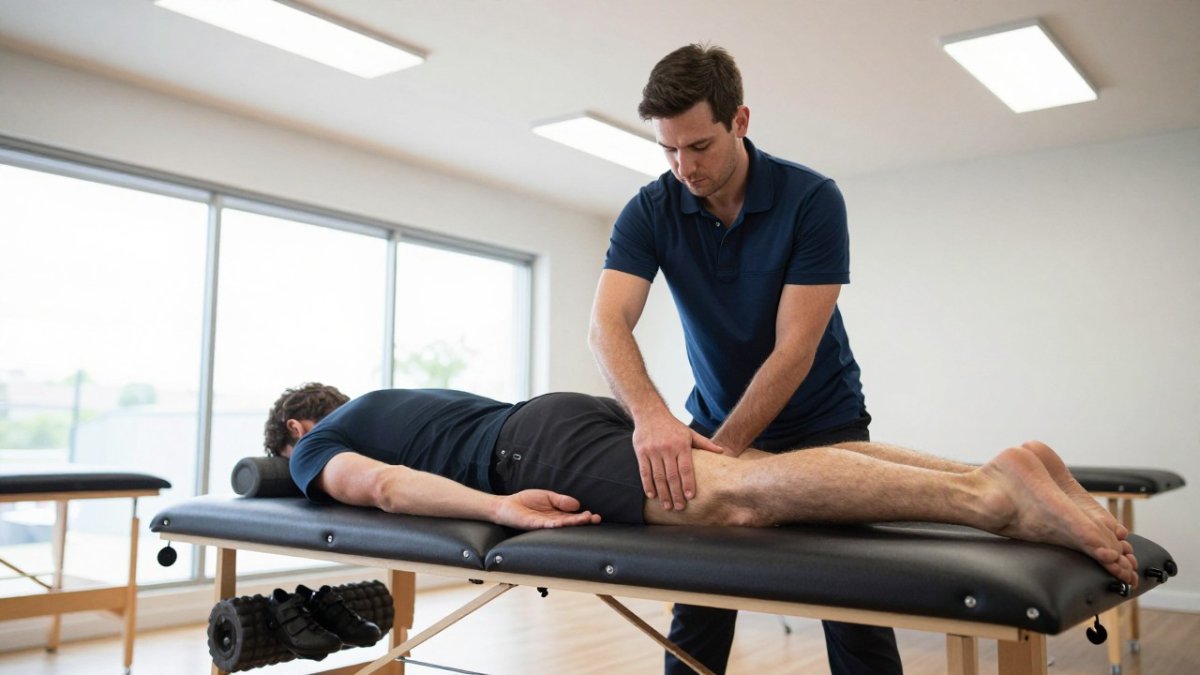
Myofascial release is a hands-on technique that applies slow, sustained pressure to the fascia, the connective tissue that wraps and links the muscles of the body. The aim is to soften areas of restriction so surrounding tissue can move more freely. (Source: musculoskeletal conditions as a major area of health care)
Fascia is not a passive wrapper. It forms a continuous web from head to foot, and when it thickens or tightens after injury, poor posture or repeated strain, that tightness can pull on structures well away from the original problem. A restricted patch in the upper back can show up as neck pain or a stubborn headache.
At Fix My Muscles, we treat myofascial restriction as a movement problem first and a pain problem second. Release the tissue, then retrain it. That is the logic behind our MARS approach, which pairs hands-on release with mobility, activation and stretch work so the change holds.
Here is the honest framing: myofascial release is not a cure for a diagnosed condition. It is a manual therapy tool that can improve tissue mobility and reduce discomfort for many people. Below we break down what the benefits actually look like, who should modify treatment, and how long results tend to last.
The Main Benefits of Myofascial Release
The benefits of myofascial release are commonly described in three areas: pain relief, tissue and joint mobility, and movement quality. What follows separates what is reasonably well supported from what is still preliminary, because the evidence base for manual therapy is uneven and it is worth knowing which claims to trust.

Pain relief and pain management
Sustained pressure on a trigger point can quiet the local tissue and reduce referred discomfort. This is pain management, not a fix for the underlying cause. Expect relief to build across a course of treatment rather than after one visit.
The evidence here is moderate rather than definitive. Reviews of manual therapy for neck and low-back pain generally find short-term improvements in pain and function when release work is combined with exercise and education, but the effect sizes are modest and the quality of individual studies varies. In plain terms: myofascial release is a reasonable part of a broader plan, not a standalone cure. The Australian Institute of Health and Welfare reports on musculoskeletal conditions as a major area of health care in Australia.
Flexibility, tissue mobility and joint range of motion
Tight fascia limits how far a joint can travel. Releasing it, then loading the new range with movement, is where flexibility gains come from. We pair release work with manual stretch therapy so the tissue is lengthened and then taught to stay there.
Movement, posture and physical function
Better tissue mobility changes how you sit, reach and lift. The gain is functional: daily tasks feel less effortful.
This is the benefit most closely tied to lasting change. Temporary relief is common; durable improvement usually depends on retraining the movement pattern that created the restriction in the first place. That is the logic behind the MARS approach, release the tissue, then build the mobility, activation and stretch capacity to hold the new range.
Which conditions have actually been studied
Rather than presenting a broad list, it helps to separate conditions with reasonable evidence from those where the support is thinner:
Neck and shoulder pain: the most studied area. Short-term pain and range improvements are commonly reported when manual therapy is combined with exercise.
Low-back pain: moderate support for short-term relief and function, again as part of a multi-modal plan.
Tension-type headache and migraine: research is preliminary and mixed, so benefit cannot be promised.
Fibromyalgia and widespread pain: some studies report modest symptom improvement; effects are small and variable.
Sports recovery and performance: benefits are often claimed but are less rigorously studied.
Watch out: treating a long-standing restriction as if it were a fresh strain often leads to over-treatment. If symptoms have changed, worsened, or come with numbness, weakness or unexplained weight loss, get assessed before any hands-on work begins.
For a broader look at how manual therapy fits alongside other approaches, the Australian Physiotherapy Association and Musculoskeletal Australia both publish plain-language resources on managing persistent musculoskeletal pain. Alongside these approaches, tracking changes in comfort and ease of movement over time can help set realistic expectations, with Trvfitberkley offering another perspective on how mobility may improve.
Here is how the evidence stacks up across the conditions the article discusses.
Condition | Level of support | What the article notes |
Neck and shoulder pain | Most studied area | Short-term pain and range gains with exercise |
Low-back pain | Moderate support | Short-term relief and function in a multi-modal plan |
Tension-type headache and migraine | Preliminary and mixed | Benefit cannot be promised |
Fibromyalgia and widespread pain | Some studies | Modest, small and variable effects |
Sports recovery and performance | Less rigorously studied | Benefits often claimed but thinner evidence |
Myofascial Release for Back Pain: What It Can and Cannot Fix
For back pain, myofascial release can ease muscular tightness and improve movement in the short to medium term. It cannot fix a structural problem, and it will not replace an accurate assessment.
What it can do: reduce guarding in the lower-back and gluteal tissue, improve hip and thoracic mobility so the spine is not overloaded, and take pressure off irritated tissue. What it cannot do: reverse a disc injury, resolve nerve compression, or undo years of poor loading in a handful of sessions. (Source: National Health and Medical Research Council guidelines)
If back pain is your main issue, our guide on whether remedial massage helps back pain goes deeper into what to expect. For fascia-specific work, myofascial cupping therapy is another tool we use alongside hands-on release.
Watch out: chasing release work while ignoring the movement pattern that caused the restriction usually means the tightness returns within weeks.
Myofascial Release vs Remedial Massage: How They Differ
Myofascial release and remedial massage overlap, but they are not the same. Remedial massage targets muscles and works across broader areas to treat pain and dysfunction. Myofascial release is more specific: slower pressure, held longer, aimed at the connective tissue and the direction its fibres run.
In practice, a remedial session often includes myofascial techniques. The difference is intent. Remedial work is about restoring function to a muscle group; myofascial work is about freeing a restriction in the sheet that surrounds it. Most treatment plans at our clinic use both, chosen to suit the presentation rather than following a fixed script.
How Long Does Myofascial Release Last?
How long any relief lasts varies between people and depends on the cause and your daily load. Lasting change comes from repeated treatment paired with movement work between sessions.
Session frequency is reviewed with your practitioner at each visit, based on your progress and needs. Frequency should be reviewed at each session, not set in stone at the first visit.
Myofascial Release Side Effects and Who Should Modify Treatment
Most people leave a session with mild soreness, similar to after exercise, that settles within a day or two. Occasionally there is temporary tenderness or a small bruise at a worked area. These are common and short-lived.
If soreness is sharp, lasts longer than a day or two, or comes with swelling, get it reviewed by your practitioner.
Who should modify or delay treatment
Some people should modify or delay treatment. That includes anyone with:
an acute injury, open wound or skin infection in the area
a bleeding disorder or current use of blood-thinning medication
a condition affecting tissue fragility, such as certain connective tissue disorders
unexplained swelling, fever or night pain
recent surgery, until cleared by the treating surgeon
Pregnant clients should discuss treatment with their practitioner and maternity care provider first. Clients with osteoporosis or a history of fracture should talk through what is appropriate before treatment begins. If you are unsure whether treatment is appropriate for you, get cleared by your GP before booking.
When to stop and seek advice
Watch out: release work should never reproduce nerve symptoms. If you feel pins and needles, numbness, shooting pain or weakness during or after a session, stop and get assessed, those are signs to investigate rather than work through. The same applies to any new symptom that does not fit the pattern you came in with.
For guidance on persistent pain and when to escalate care, Musculoskeletal Australia and the Australian Commission on Safety and Quality in Health Care both provide consumer-focused information on safe, appropriate care.
Professional Treatment vs Self-Release: What Works Better
Self-release with a foam roller or ball can support maintenance between visits.
Professional treatment can combine hands-on work with stretch and activation in the same session, while self-release can support maintenance between visits.
If you want to compare the professional option, you can review our remedial massage service and see how it fits your situation.
Book a Hands-On Assessment at Fix My Muscles
A proper assessment can help identify which tissue may be restricted and what a suitable treatment approach could look like.
At Fix My Muscles, our therapists combine remedial and sports massage with dry needling, myofascial cupping and manual stretch therapy, structured through the MARS approach. We work with chronic pain, sports injuries and restricted mobility, and HICAPS private health fund rebates are available. If you have tried other treatments without the result you wanted, book an assessment to discuss your situation.
Book a hands-on assessment at Fix My Muscles and get a clear plan for your pain and mobility.
Frequently Asked Questions
What does myofascial release help with?
Myofascial release is used for muscle tightness, stiffness, restricted movement and pain in areas such as the back, neck and shoulders. It aims to reduce tension in the soft tissue and fascia so joints move more freely. People often seek it for chronic pain, injury recovery and post-training soreness. Results vary between people and conditions, so a hands-on assessment is the best way to find out whether it suits your situation.
How long do the effects of myofascial release last?
It depends on the problem, how long you have had it and what you do between sessions. Some people feel looser and more comfortable for several days after a single treatment. Lasting change usually comes from repeated sessions combined with mobility and strengthening work at home. Your therapist can give you a realistic timeline after assessing your movement and symptoms.
Can myofascial release make you sore afterwards?
Mild soreness for a day or two is common, similar to how muscles feel after unaccustomed exercise. It usually settles on its own. Tell your therapist if you are sore for longer than that or if soreness is severe, and mention any medications or health conditions before treatment. Some people need lighter pressure or a modified approach, particularly during pregnancy or after recent injury.
Is myofascial release the same as remedial massage?
They overlap but are not identical. Remedial massage is a broad approach to soft tissue problems, while myofascial release focuses on sustained, gentle pressure into fascia and connective tissue to reduce restriction. Many clinics combine both. Fix My Muscles uses the MARS approach, combining Mobility, Activation, Release and Stretch, so treatment is tailored to how your body moves rather than following one fixed technique.


Comments