


How to Use Mobility Exercises for Tight Glutes in Runners
Last Updated: November 7, 2026
Quick Summary
Use mobility exercises for tight glutes in runners as dynamic drills before a run and save static stretches for afterwards. A 4-6 minute pre-run sequence of hip circles, leg swings, 90/90 switches and fire hydrants restores range, while glute stretches held 30-45 seconds per side work best post-run.
Tight glutes shorten your stride and make hamstrings or the lower back compensate.
If you can reach a position passively, you need activation and strength rather than more stretching.
Hold glute stretches 30-45 seconds per side, repeated two to three times.
Static stretching before running can blunt power output, so keep pre-run work dynamic.
Test single-leg stability by standing on one leg for 30 seconds and watching for hip drop.
Tight glutes slowing your running?
Hands-on assessment and treatment for runners with hip tightness and restricted mobility.
Table of Contents
Why Tight Glutes Affect Your Running Stride
Tight glutes in runners change how the whole leg moves.
The glutes are the engine of your running stride. The gluteus maximus drives hip extension, while the gluteus medius controls hip stability through every single-leg stance. When either loses mobility or activation, running mechanics change.
Common signs tight glutes are affecting your running:
Shorter, choppier stride length
Hip tightness that lingers after runs
One hip hitching or dropping when you run
Hamstring or lower back tightness that keeps returning
The Australian Institute of Sport notes that muscle imbalance and restricted range of motion are recurring themes in running-related injuries.
Mobility, Stretching, Activation or Strength: What You Actually Need
Most runners treat these four as interchangeable. They aren't, and mixing them up is the main reason a stretching routine stops working.
Mobility work restores range of motion at the joint. Think hip flexion and external rotation.
Stretching lengthens tissue that is genuinely short. Held stretches belong here.
Activation wakes up a muscle that has gone quiet, usually the gluteus medius.
Strength builds the capacity to hold that range under load.
Here's the decision rule we use: if your hip feels stiff but you can reach the position passively, you need activation and strength, not more stretching.
Get that order wrong and you'll stretch a muscle that was never tight in the first place.
Glute Stretches for Runners That Target Hip Tightness
Glute stretches for runners work best when held long enough to let the tissue settle. Move into each stretch slowly, breathe, and stop before you feel sharp pain.
Three stretches cover most of what runners need:
Figure-four stretch: Lie on your back, cross one ankle over the opposite knee, and draw the legs in. Hold 30-45 seconds per side.
Seated glute stretch: Sit tall, cross one ankle over the opposite knee, and lean forward from the hips. Hold 30-45 seconds.
Downward-facing dog: A whole-posterior-chain stretch that also opens the hips. Hold 30-60 seconds.
A common mistake is bouncing into the stretch. That triggers a protective reflex and the muscle tightens instead of releasing.
Figure-Four Stretch, Pigeon Pose and Seated Variations
Pigeon pose is the deepest of the hip-opening stretches.
Pigeon pose: From all fours, bring one knee forward behind the same-side wrist and extend the other leg back. Sink slowly. Hold 30-45 seconds.
Seated figure-four: Sit in a chair, ankle over the opposite knee, and lean forward with a flat back.
If pigeon pose produces knee pain, back off. The figure-four stretch gives most of the benefit with far less joint load.
Hip Mobility Exercises for Runners to Restore Range of Motion
Hip mobility exercises for runners should be dynamic, not static. Save the held stretches for after your run and use movement-based drills before it.
A practical way to structure this is a short pre-run sequence of four to six minutes, followed by a longer mobility session on a rest day or after an easy run. The pre-run version is about preparation; the longer version is about gradually expanding range.
Pre-run mobility sequence (4-6 minutes):
Hip circles: 8-10 slow circles each direction, standing tall with one hand on a wall for balance. Keep the pelvis still and let the hip do the work.
Leg swings, front-to-back: 10-12 controlled swings per leg. Start small and let the range build across the set rather than forcing the end range on rep one.
Leg swings, side-to-side: 10 controlled swings per leg. This opens the adductors and helps the hip accept the lateral forces of single-leg stance.
90/90 hip switches: 6-8 slow switches per side, seated on the floor. Move from one side to the other without using your hands to push.
Fire hydrants: 8-10 reps per side, keeping the pelvis level and the low back still.
Half-kneeling hip flexor rocks: 8 slow rocks per side, tucking the pelvis under before rocking forward.
Rest-day or post-run mobility session (10-15 minutes):
Repeat the same drills for two to three rounds, adding a longer hold at the end range of each rep. This is where range tends to expand, because the tissue is warm and the nervous system is more willing to accept a new position.
How to progress:
Add reps before adding range. Two extra reps per drill is a safer progression than pushing deeper into a position you cannot control.
Progress from two rounds to three before adding new drills.
Once the pre-run sequence feels easy, add a light resistance band around the thighs for the fire hydrants and 90/90 switches.
Re-test every two to three weeks using simple self-checks, such as whether you can sit cross-legged with both knees closer to the ground than when you started.
Running-specific transfer:
Mobility work only matters if it shows up in your stride.
Watch out: forcing range you don't own yet is how runners irritate the hip joint.
If a drill consistently reproduces pain, stop and have the hip assessed rather than pushing through.
Glute Activation Exercises for Runners Before Every Run
Glute activation exercises for runners take five minutes and change how your hip feels for the whole session. The goal is simple: switch the gluteus medius on before you ask it to stabilise your stride.

(/product-page/resistance-loops) come in four levels so you can build from light to extra heavy as control improves.
How Long to Hold Glute Stretches for Best Results
Hold glute stretches for 30 to 45 seconds per side, repeated two to three times. That's the range most runners respond to. Shorter holds don't give the tissue time to release, and longer holds don't add much beyond that.
Timing matters as much as duration:
Before a run: dynamic mobility only, no long holds. Static stretching before running can blunt power output.
After a run: this is your window for static stretching and post-run recovery work.
On rest days: a longer mobility routine, 10-15 minutes, pays off.
The Sports Medicine Australia recommends tailoring stretching to the individual rather than following a fixed template.
Breathe out as you settle into each hold. Holding your breath tightens everything you're trying to release.
Here is the timing that matters for glute stretches and mobility work.
Item | Value | Note |
Glute stretch hold | 30-45 seconds per side | Repeated two to three times |
Downward-facing dog hold | 30-60 seconds | Whole-posterior-chain stretch |
Pigeon pose hold | 30-45 seconds | Deepest hip-opening stretch |
Before a run | Dynamic mobility only | No long holds |
After a run | Static stretching window | Post-run recovery work |
Rest days | 10-15 minutes | Longer mobility routine |
Building Single-Leg Stability and Glute Strength
Single-leg stability is where glute strength turns into better running mechanics.
Test yourself first:
Stand on one leg for 30 seconds and watch your hip in a mirror.
Exercises that build it:
Single-leg squat: 3 sets of 6-8 per side, controlled depth to a chair or bench. Keep the knee tracking over the middle toes.
Bulgarian split squat: 3 sets of 8 per side. Start with bodyweight and add load only when the pelvis stays level through the whole set.
Single-leg deadlift: 3 sets of 8 per side, slow and steady. The goal is a still pelvis, not a deep hinge.
Step-downs: 3 sets of 10 per side off a low step, lowering slowly over three seconds.
Lateral band walks: 10-12 steps each direction, band above the knees, pelvis level.
How to progress:
Progress by adding reps before adding load. Clean movement beats heavy movement every time.
Running-specific transfer:
Strength work should show up in how you run, not just in the gym. Practical markers to watch over four to six weeks:
Less hip drop or hitching when you watch yourself run on a treadmill or in a window.
A more stable feeling on uneven ground and cambered footpaths.
Less post-run hip and low back tightness after longer efforts.
A single-leg stance that feels steadier for the full 30 seconds.
Track these in a simple note on your phone after your long run each week.
When to modify:
If a movement produces sharp hip, knee or groin pain, reduce the range or swap to a supported version.
When Tight Glutes Need Hands-On Treatment
Some tight glutes don't respond to self-care.
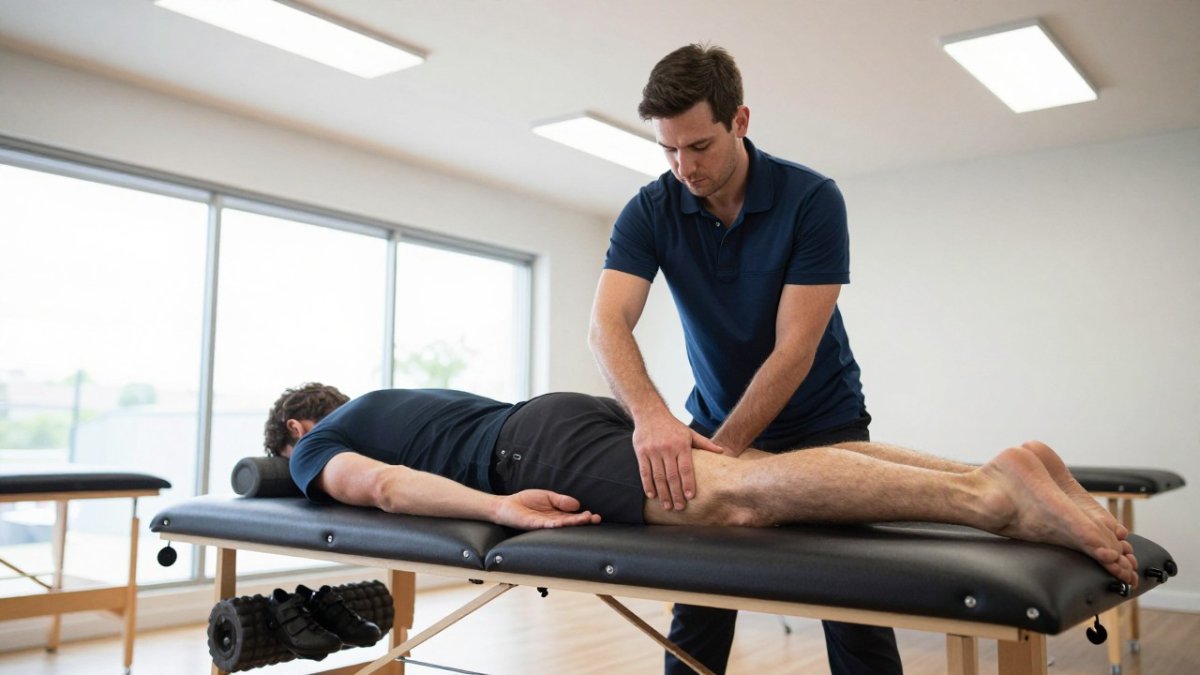
That's where hands-on treatment earns its place. At Fix My Muscles, we use the MARS approach, which combines Mobility, Activation, Release and Stretch around what each client actually needs.
Manual stretch therapy is useful when foam rolling and passive stretching have plateaued.
Runners often ask when to schedule treatment. Our guide to runners and massage explains how massage fits into a training week.
Booking a Glute and Hip Assessment
An assessment can help identify whether mobility, stretching, activation or strength work is most relevant for you, rather than guessing. Our sports injury service may be relevant to this kind of problem.
If tight glutes have stalled your running, book an appointment online to discuss what may be driving it.
Tight glutes rarely fix themselves with a few token stretches. They need the right work in the right order, and sometimes they need hands-on release to get moving again.
Frequently Asked Questions
Should runners stretch tight glutes before or after a run?
Save static glute stretches for after your run, when muscles are warm and more receptive to lengthening. Before running, use dynamic work instead: leg swings, walking lunges and glute bridges to wake up the gluteus medius and gluteus maximus. A five-minute dynamic warm-up routine improves glute activation without dulling the stretch reflex. If hip tightness is pronounced, a short mobility routine after the run, followed by static holds, gives the best balance between performance and range of motion.
Can weak glutes contribute to tightness when running?
Yes. Weak gluteus medius and gluteus maximus muscles often cause other hip structures to overwork, which presents as tight glutes and hip tightness. A muscle imbalance like this changes running mechanics, increases pelvic drop and raises injury risk over time. That is why activation exercises such as clamshells, monster walks and single-leg squats belong alongside stretching. Strengthening the glutes while mobilising the hip gives a more durable result than stretching alone.
What is the difference between glute mobility and glute stretching?
Stretching lengthens a muscle at its end range, while glute mobility work moves the hip joint through its full range of motion under control. Mobility exercises for tight glutes in runners include hip circles, fire hydrants and controlled hip flexion and external rotation drills. Stretching is a useful tool, but mobility work teaches the nervous system to use the range you gain. Pairing both, plus activation and strength exercises, addresses stiffness and the underlying control problem.
When should a runner seek help for persistent glute tightness?
If tight glutes persist beyond two to three weeks of consistent mobility and strength work, or come with pain, altered running stride or limited range of motion, book an assessment. A hands-on practitioner can check for muscle imbalance, trigger points and joint restriction that self-directed stretching will not resolve. Manual stretch therapy, remedial massage and dry needling are options a qualified therapist may use to release tissue and restore hip stability before you return to full training.


Comments